
Wolf Dog Misconceptions
Take whatever you’ve been told about wolf-dog hybrids and throw it in the trash—because chances are, you may have been misinformed or given information by people who have never actually experienced life with these glorious creatures. Everyone is captivated by them, but very few are truly prepared for what they can bring into your life.
Before we get into the misconceptions, let’s clear something up: wolfdogs are not just “wild-looking dogs,” and they are not a new trend that suddenly appeared because people wanted an exotic pet. Their history is complicated, their genetics are often misunderstood, and the label itself is used far too loosely.
Wolfdogs did not just come from one place or suddenly appear one day. Wolves and domestic dogs are closely related enough to breed and produce offspring, which means wolf–dog crosses have happened in different parts of the world for a very long time. However, the wolfdogs people know today were mostly shaped by intentional breeding programs and private breeders, especially throughout the 1900s.
One thing people often get wrong is confusing the history of dogs with the history of wolfdogs. Yes, domestic dogs came from ancient wolf populations thousands of years ago—but that does not mean every dog has “wolf” in it or that every dog with a wolf-like appearance is a wolfdog. A Husky, Malamute, or German Shepherd is not automatically a wolfdog just because they look more “wolfy” than other breeds.
There are a few more well-known wolfdog lines that were intentionally developed. The Saarloos Wolfdog was developed in the Netherlands in the 1930s, while the Czechoslovakian Wolfdog was developed through a military breeding program in what was then Czechoslovakia during the 1950s. These dogs were intentionally bred using wolves and domestic dogs, but they are very different from the random, poorly documented animals people may see online being labeled as “high-content wolfdogs.”
The truth is that the term “wolfdog” gets thrown around far too easily. Some wolfdogs may be only a few generations removed from a pure wolf, while others may have distant wolf ancestry that is difficult to verify. You cannot reliably determine wolf content by looking at a dog’s coat color, eyes, size, or how much they “act like a wolf.” Documented lineage and appropriate genetic testing matter far more than appearance.
Crux Pet Adoptions: Kiera (on the left) and Declan (on the right) howling to sirens going off in the far distance.
I have personally volunteered at a wolfdog rescue called Crux Pet Adoptions in Eugene, Oregon. The owner started the rescue because there was such a lack of humane placement options for dogs—especially wolfdogs. She has taken in animals from across the country, including wolfdogs with serious behavioral histories—some that have harmed people and others that have killed cats, small dogs, or other animals. These are not easy cases, and they are not animals that can safely be handled with wishful thinking or treated like a typical pet dog.
I have learned an immense amount from her, including how she works and trains with her wolfdogs. Her approach is a little different from my own, but the environment and the risks are different, too. She uses tools such as prong collars and e-collars with certain wolfdogs as part of an individualized handling plan. The purpose is not to be harsh or to take shortcuts. It is about maintaining control in high-stakes situations and protecting the children, cats, dogs, and other animals around them.
When an animal has an intense prey drive, strength, and a history of dangerous behavior, you cannot make safety depend on hoping a “leave it” or recall will work every single time. Secure containment, supervision, physical separation, and experienced handling always have to come first. Wolfdog-focused safety guidance emphasizes that prey drive may not be controlled through verbal commands alone and that secure containment is essential.
My own training style is built around creating a positive relationship with the dog. I want the animal to trust me, understand what I am asking, and feel safe working with me. I do not personally use prong collars, although I understand how they work and why some handlers may choose them in specific situations. If I believe an additional tool is absolutely necessary, I may use an e-collar carefully and minimally—not as a daily training crutch, not out of frustration, and never as a replacement for management or relationship-building. The goal is always to use the least amount of pressure necessary while still keeping everyone safe.
At the end of the day, no tool makes a wolfdog safe on its own. Training, trust, secure containment, responsible management, and realistic expectations are what truly protect the wolfdog and the people and animals around them.
This is why I am writing this: to bring awareness to the wolfdog breeding epidemic. Too many people are breeding and selling wolfdogs without truly understanding what they are producing, what those animals may grow into, or where they will end up when the buyer realizes they are in over their head. These are not just “rare,” beautiful, wild-looking puppies to market online for thousands of dollars. They are living animals with complex needs, intense instincts, and the potential to become dangerous in the wrong home or without proper management. When breeders sell them to people who are not prepared, do not properly educate them, or make unrealistic promises about how “easy” they will be, rescues are the ones left to pick up the pieces. And unfortunately, the wolfdogs are usually the ones who pay the price.
I have Casey trailing behind me on the left and Abe on the right. Both were adopted and are living their best lives!
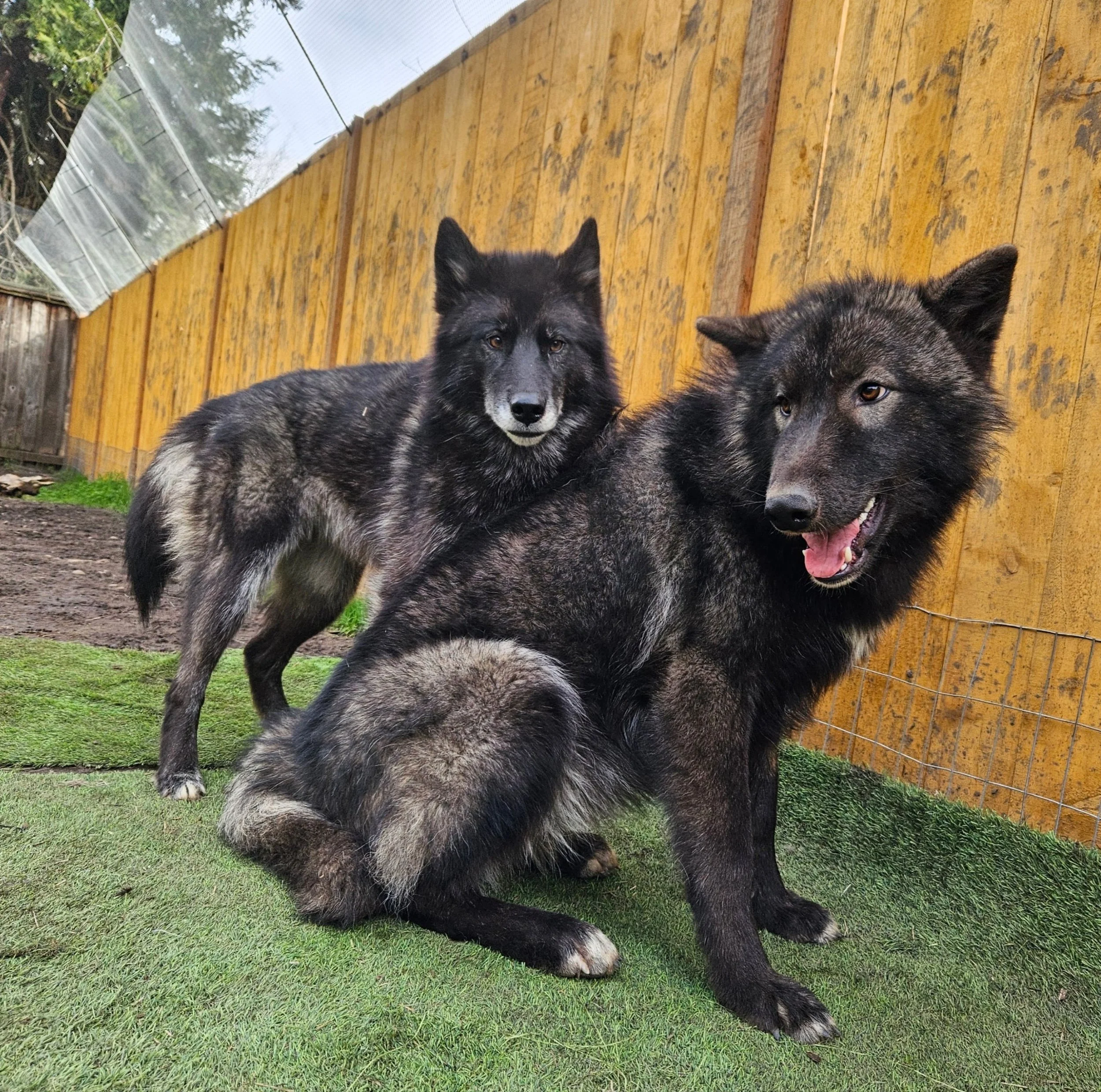
Crux Pet Adoptions: Shoneah aka “Sho” on the left and Hunter is on the right: both are up for adoption!
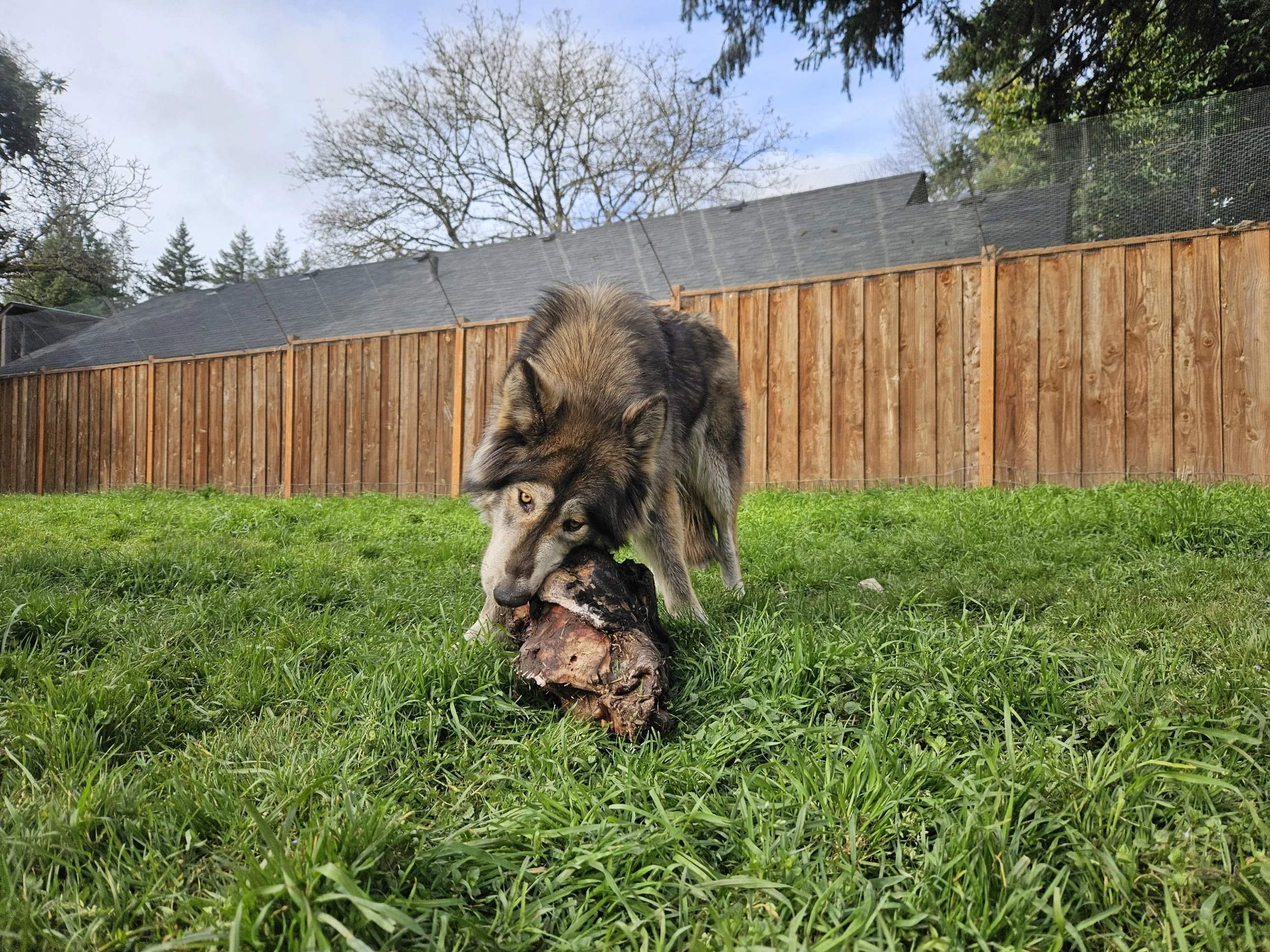
Crux Pet Adoptions: Kiera chomping down on a cattle skull. She is up for adoption!
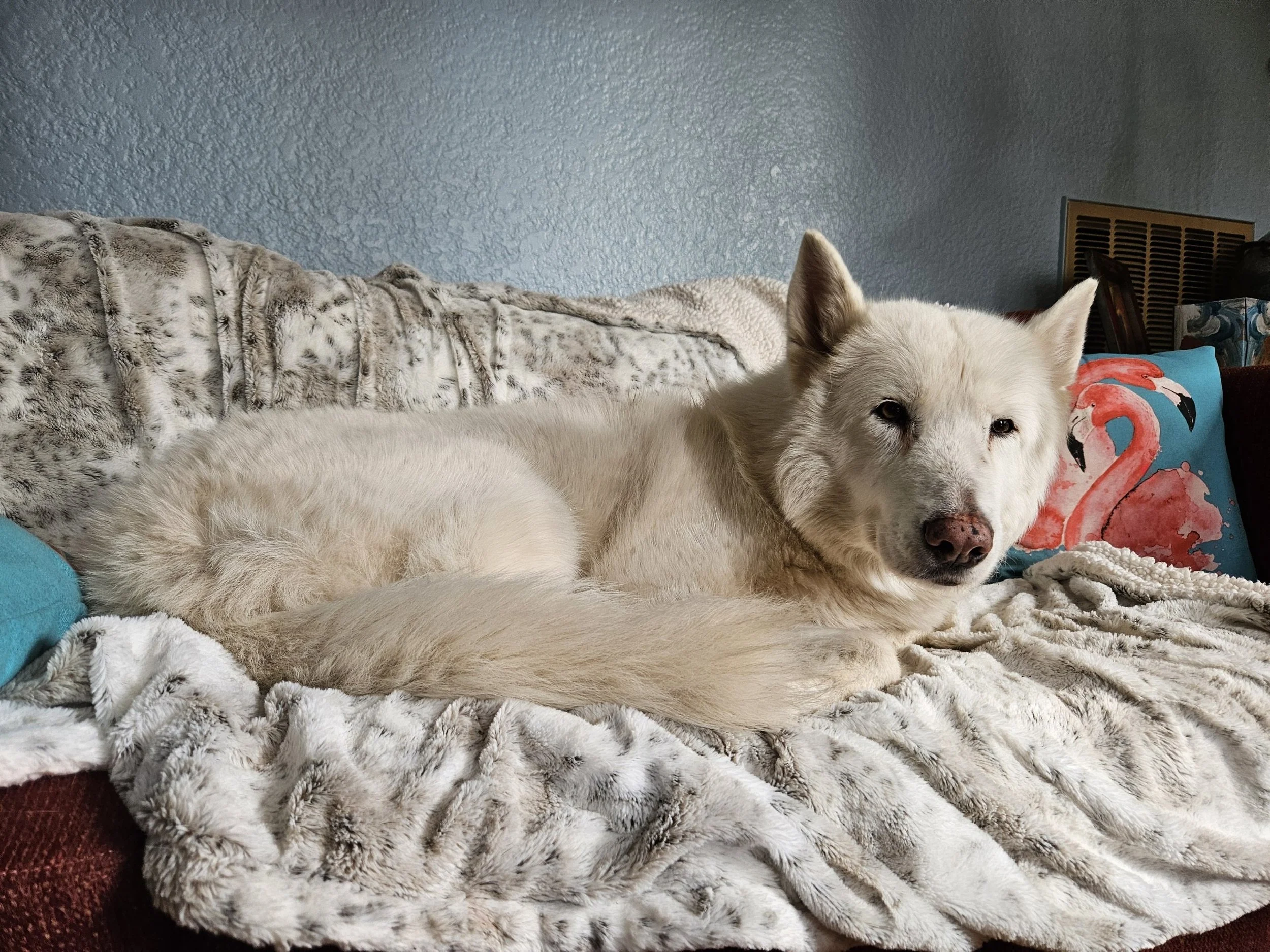
Crux Pet Adoptions: Nova was the first wolf dog rescued and placed in this rescue and has recently passed away at 14 years old. She lived her best life up until the end. Consider volunteering, donating, or spreading awareness to help these guys get the happy ending they deserve.
Crux Pet Adoptions
I want to give a huge thank you to Crux Pet Adoptions in Eugene, Oregon, for everything they do for wolfdogs and other animals. Volunteering there has taught me so much about wolfdogs, rescue, proper management, and what it truly takes to care for animals that are not always easy or safe for the average home. They do not just find animals a place to go—they work to find the right placement, provide support, and make sure both the animals and the people around them can stay safe.
If you want to learn more about wolfdogs, are interested in adoption, fostering, want to donate or volunteer, or simply want to find another way to help, please check out Crux Pet Adoptions and support the work they do!
Sources and Further Reading
International Wolf Center. “Get Facts About Wolf-Dog Hybrids.”
https://wolf.org/wolf-info/basic-wolf-info/wolves-and-humans/wolf-dog-hybrids/
Freedman, Adam H., et al. “Grey Wolf Genomic History Reveals a Dual Ancestry of Dogs.” Nature, 2022.
https://www.nature.com/articles/s41586-022-04824-9
Caniglia, Romolo, et al. “Identification of Wolf-Dog Hybrids in Europe.” Frontiers in Ecology and Evolution, 2021.
https://www.frontiersin.org/journals/ecology-and-evolution/articles/10.3389/fevo.2021.760160/full
Wolf Haven International. “Wolfdogs.”
https://www.wolfhaven.org/education/materials/wolfdogs
“A Legacy of Genetic Entanglement With Wolves Shapes Modern Dogs.” Proceedings of the National Academy of Sciences, 2025.
https://pmc.ncbi.nlm.nih.gov/articles/PMC12684911/
China, Lisa, et al. “Efficacy of Dog Training With and Without Remote Electronic Collars Compared to Reward-Based Training.” Frontiers in Veterinary Science, 2020.
https://pmc.ncbi.nlm.nih.gov/articles/PMC7387681/
Cooper, Jonathan J., et al. “The Welfare Consequences and Efficacy of Training Pet Dogs With Remote Electronic Training Collars.” PLOS ONE, 2014.
https://journals.plos.org/plosone/article?id=10.1371/journal.pone.0102722
American Veterinary Society of Animal Behavior. “Humane Dog Training Position Statement.”
https://avsab.org/resources/position-statements/
